
How to Choose the Right Lampshade Size for Your Lamp
This is the question I get asked more than any other. Someone sends me a photo of a lamp base they inherited or found at a market, and asks what shade to put on it. So I thought I would write down how I think about it, partly so I have somewhere to point people, and partly because the answer matters more than it sounds like it should.
A wrong-sized shade quietly undoes a beautiful lamp. Too small and the base looks lost on the table. Too big and it bullies the room. But once you know two things I am about to share, you can size most lamps in about thirty seconds without a tape measure the first pass.
The two rules
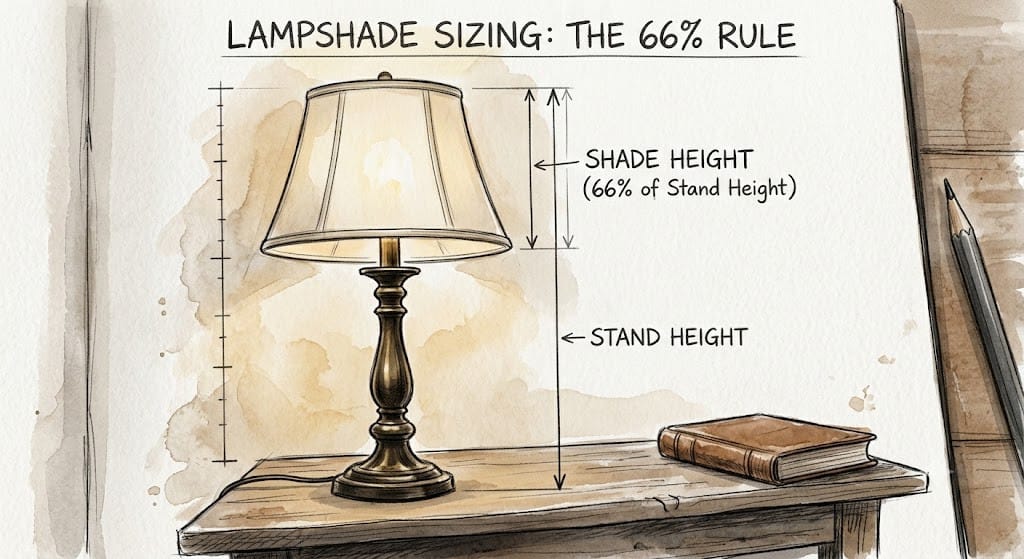
Rule one. The shade wants to be about two-thirds the height of the base. You measure the base from where it sits on the table up to the top of the socket, then multiply that by 0.66 in your head. Or just take two-thirds and call it done. A 30cm base wants a shade around 20cm tall. A 45cm base wants something around 30cm. The maths is loose on purpose. Eyes round to what looks right.
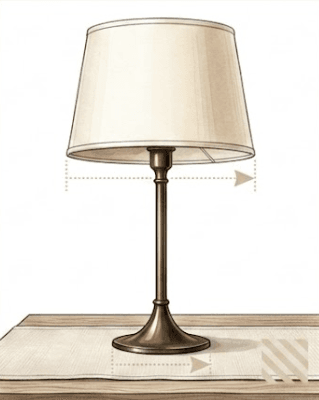
Rule two. The shade should be at least as wide as the widest part of the base, and usually wider. A narrow candlestick base wants a shade that flares out past it. A wider sculpted base like our Beaumont wants a shade that matches its visual weight. Too narrow at the base looks pinched. Too wide makes the lamp look top-heavy.
Which size fits your lamp?
Measured your base? Use the two rules above, then pick the size that matches. Between two sizes, go up.
Between sizes, or an unusual base? June makes to measure. WhatsApp her a photo of your lamp and she will tell you which size will sit right.
Sizes I would suggest by lamp type
For a bedside lamp, most South African bases sit around 30 to 45cm tall. A 30cm shade paired with a substantial base works. A 25cm shade on something shorter or with a very slim profile. If you are pairing two bedsides, match them exactly. Two different shades on either side reads as accident rather than intention.
For a living room console or side table lamp, you are looking at bigger totals. 35 to 45cm shade diameter suits most substantial bases. Go larger if it sits alone against empty wall space. Go smaller if it is in a busy vignette. The mistake I see most is going smaller because you do not want the lamp to dominate. That leaves you with a lonely-looking shade on top of a substantial base. Trust the maths and go up.
For a floor lamp, 45 to 55cm diameter. Ours only run to 45cm in the standard range, so anything larger is a commission.
The fitter question
The thing nobody talks about. Your base has one of two ways for a shade to attach. Ring fitter is common on most modern South African bases, where a metal ring inside the top of the shade sits over a hoop on the base and a finial screws down over it. Clip fitter is on smaller bedside and candlestick bases, where a small frame inside the shade clips directly onto the bulb.
If you do not know what your base uses, look at the top of your existing shade or measure the socket. Send me a photo before you order if you are not sure. I would much rather answer the question than have you order the wrong thing.
What I would not do
Buy the smallest size on offer because you feel nervous about scale. The bigger shade almost always reads as more confident. If you are stuck between two sizes, go up.
Match the shade colour to the base colour. It sounds intuitive but it flattens the lamp. Shades work best when they harmonise with the room, not the base.
Skip the measuring. Photos lie about scale. A base that looks average in a listing can be huge or dinky when it arrives.
A few shades that follow these rules
If you would like to see the two-thirds rule and the width rule in a finished shade, these four are useful to look at. Each one is sized so it sits comfortably on the sort of bases most of my customers already own.
- Moss Climber: one of my most popular prints, a small leafy pattern that sits happily on medium to larger bases.
- Oat and Ochre: a soft, warm print that brings a gentle glow to a bedroom, lovely on a bedside or side-table lamp.
- Amberwave: a warm-toned shade for wooden or ceramic bases in the same warm family.
- Pillemont Toile: classic blue and white, the one I reach for when a lamp needs presence without shouting.
If none of those feel right, the two rules still apply. Measure your base, work out two-thirds, and pick something at least as wide as the widest part of it. You will get close.
Ready to choose? Shop by size
Now that you know your size, here is every shade I make in it, across all my ranges, shown at that size’s price.
If you would like a hand
Not sure which size? Send me a photo.
Photograph your lamp base with a mug or a book next to it for scale and I will tell you which shade will sit right. No obligation, usually same day.
Prefer to browse? See the handmade gathered lampshades and pair-pick against a base you already have.
June
Enclave Decor Co.
More studio notes and guides live in Workshop Notes, and if you are wondering who is behind the pleats, that is on Our Story. Everything here is made to pair with our bobbin lamp bases.
